
Stress is the body’s natural response to pressure, demands, challenges, or change. It is a normal part of life and, in small amounts, can help motivate us to take action, stay focused, and achieve our goals. However, when stress becomes frequent or prolonged, it can affect our physical health, emotional well-being, relationships, and overall quality of life.
We all experience stress differently. It may stem from work pressures, financial concerns, relationship difficulties, health issues, major life changes, or the increasing demands of our technology-driven world. Understanding the different types of stress, recognising our personal triggers, and developing healthy coping strategies can help us build resilience and maintain a healthier balance in our daily lives.
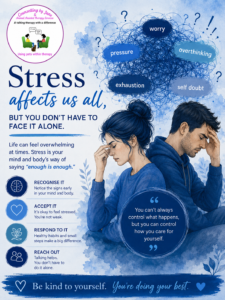
Stress is the body’s natural response to pressure, challenges, or change. When we face a stressful situation, our body activates a “fight-or-flight” response to help us cope. However, when stress becomes constant, it can begin to impact our health, relationships, productivity, and overall quality of life.
Stress can show up in different ways, and recognising the type of stress you’re experiencing is often the first step towards managing it.
Mental Stress Common Signs:
Mental stress affects our thinking and ability to focus. It can be triggered by heavy workloads, deadlines, decision-making, or information overload.
Mental stress affects our thinking and ability to focus. It can be triggered by heavy workloads, deadlines, decision-making, or information overload.
Emotional Stress Common signs:
Emotional stress is linked to feelings such as fear, uncertainty, disappointment, grief, or relationship difficulties.
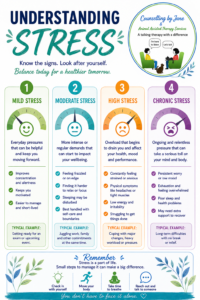
Physical Stress Common Signs:
Physical stress occurs when the body is overworked or not functioning at its best due to illness, fatigue, injury, or lack of sleep.
Behavioural Stress Common Signs:
Behavioural stress is often reflected in our habits and actions.
Spiritual Stress Common Signs:
Spiritual stress can arise when we struggle with our purpose, values, beliefs, or sense of meaning, particularly during times of loss, change, or uncertainty.
Technology-Related Stress Common Signs:
Technology has become an increasing source of stress. Constant notifications, virtual meetings, emails, and the pressure to always be available can contribute to digital fatigue.
Stress triggers vary from person to person, but some common examples include:
One of the most effective ways to manage stress is to identify what triggers it. A simple way to do this is to keep a stress journal and record:
Over time, patterns will begin to emerge, helping you understand what situations, people, or circumstances have the greatest impact on your stress levels. Once you know your triggers, you can take proactive steps to manage them more effectively.
When left unmanaged, stress can affect every aspect of our lives.
Physical effects:
Mental and emotional effects:
Social and professional effects:
While we can’t always eliminate stress, we can develop healthier ways to manage it.
Prioritise Self-Care
Keep Active
Manage Your Mindset
Build Emotional Support
Support Your Spiritual Well-being
Set Healthy Technology Boundaries
Improve Time Management
Practice Relaxation Techniques
Seek Support When Needed
Over the years, I have worked with many clients who come to counselling feeling overwhelmed by life’s challenges and struggling to cope with the stress they are experiencing. Often, they feel exhausted, stuck in unhelpful patterns of thinking, or unsure how to move forward. Counselling provides a safe, supportive space to explore what is contributing to the stress, increase awareness of how thoughts, feelings, and behaviours are connected, and develop healthier ways of responding. With greater self-understanding and the right support, it becomes possible to manage stress more effectively and regain a sense of balance, control, and well-being.
Stress affects everyone differently and can be mental, emotional, physical, behavioural, spiritual, or technology-related. By recognising the signs, identifying our personal triggers, and using healthy coping strategies, we can build resilience and better manage life’s challenges.
The goal isn’t to eliminate stress completely—it’s to develop healthier ways to respond to it while maintaining balance, well-being, and a sense of purpose.
Over the years, I have worked with many clients who come to counselling feeling extremely stressed by life’s challenges and are struggling to cope with the stress and feelings they are experiencing. Often, they feel exhausted, stuck in unhelpful patterns of thinking, or unsure how to move forward.
Counselling provides a safe, supportive space to explore what is contributing to the stress, increase awareness of how thoughts, feelings, and behaviours are connected, and develop healthier ways of responding. With greater self-understanding and the right support, it becomes possible to manage stress more effectively and regain a sense of balance, control, and well-being.
Jane Hupston, MBACP (Accred), NCS (Senior Accred).
Date written 22/7/2026
Jane Hupston is an experienced Integrative Counsellor and Clinical Supervisor working with adults & adolescents experiencing anxiety, overwhelm, stress, relationship difficulties, bereavement, low self-esteem, and life transitions and lots more issues.
Drawing on a range of evidence-based approaches, including Person-Centred Therapy, Solution Focused Therapy, Dialectical Behaviour Therapy (DBT), and Cognitive Behavioural Therapy (CBT), Jane tailors her work to the unique needs of each individual.
Through her counselling practice, Jane supports clients in developing practical coping strategies, strengthening emotional resilience, and creating meaningful, lasting change in their lives.
To book an appointment please ring Jane on 07792847171