
There are times in life when everything seems to arrive at once. Work demands increase, family responsibilities pile up, relationships feel strained, unexpected problems appear, and our minds become crowded with worries about what might happen next.
This is often what overwhelm feels like.
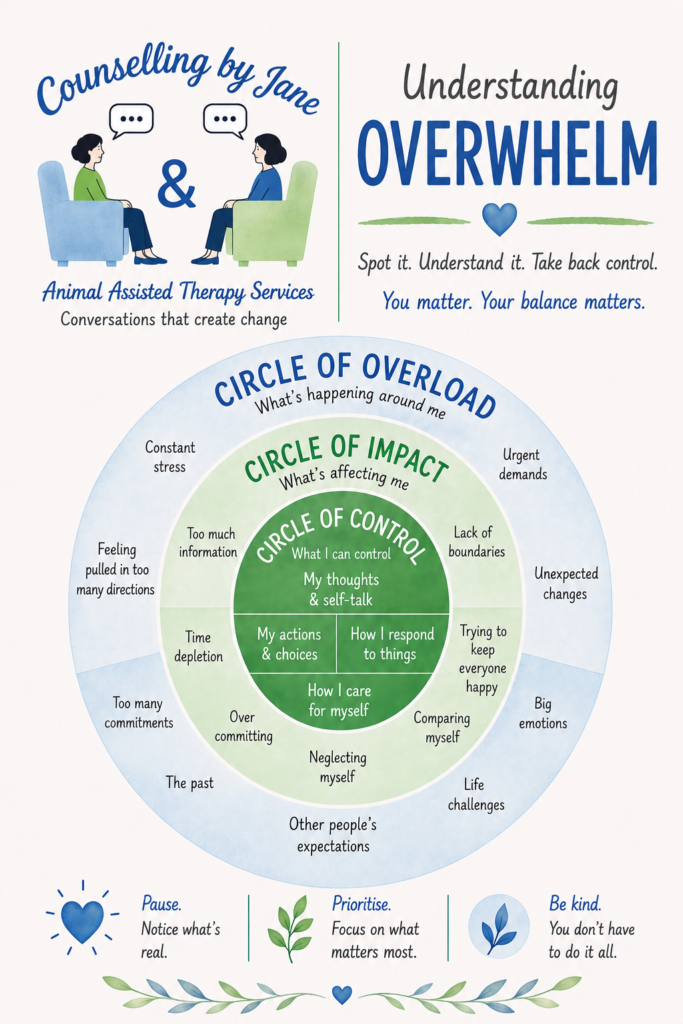
Overwhelm is more than simply having a lot to do. It is the emotional, mental, and physical experience of feeling as though the demands being placed upon you exceed your ability to cope in that moment. When overwhelm takes hold, it can leave you feeling anxious, exhausted, tearful, irritable, disconnected, or unable to think clearly.
As an Integrative Counsellor, I work with many people who come to therapy feeling completely overwhelmed by life. Often, they arrive believing there is something wrong with them because they can no longer cope in the way they once did. In reality, they are usually carrying far more than anyone was ever meant to manage alone.
One of the benefits of an integrative approach is that I can draw upon different therapeutic modalities depending on what best suits the person sitting in front of me. Sometimes a Solution Focused approach can help clients identify practical steps forward and regain a sense of control. At other times, Dialectical Behaviour Therapy (DBT) techniques can help people regulate intense emotions, manage distress, and respond more effectively when life feels overwhelming.
The good news is that overwhelm is not a sign that you are failing. More often, it is a signal that your mind and body are trying to manage too much at once. Understanding what is happening, and learning how to respond to it differently, can help you move from feeling stuck and powerless to feeling calmer, clearer, and more in control.
One of the biggest misconceptions about overwhelm is that it means we are not coping well enough. Many people tell themselves they should be stronger, more organised, or somehow able to “just get on with it.”
In reality, overwhelm is often the nervous system’s response to prolonged stress, uncertainty, emotional strain, or competing demands. When we perceive that there is more to manage than we have the resources to handle, our brain shifts into protection mode.
When this happens, clear thinking becomes more difficult. We can struggle to prioritise, make decisions, or see solutions. Instead, our attention is drawn towards whatever feels urgent, threatening, or unresolved.
When we are overwhelmed, our world often becomes much smaller.
We become focused on everything that is unfinished, everything that could go wrong, or everything that feels out of our control. The bigger picture becomes difficult to see.
A challenging conversation can suddenly feel like the end of a relationship. A setback at work can convince us we are failing professionally. A single problem can start to overshadow all the things that are going well.
This is because overwhelm encourages all-or-nothing thinking. We lose sight of the grey areas and begin viewing situations through the lens of stress and fear.
Have you ever looked at a simple email and felt unable to reply? Or stared at a household task you would normally complete without thinking, yet somehow it felt enormous?
This is one of the most common signs of overwhelm.
The issue is rarely the task itself. Rather, the emotional and mental energy required to manage everything else has already exhausted much of your capacity.
When your brain is busy processing worries, stress, responsibilities, or strong emotions, even the smallest additional task can feel like one demand too many.
This is why self-criticism is rarely helpful. The problem is not laziness or lack of motivation; it is often emotional overload.
Being busy does not automatically mean being overwhelmed.
Many people lead full and demanding lives while still feeling capable, focused, and in control. When we feel supported, rested, and able to manage what is in front of us, a busy life can even feel rewarding.
Emotional overload is different.
It happens when life’s demands begin to outweigh our perceived ability to cope with them. This may be due to stress, grief, health concerns, uncertainty, relationship difficulties, burnout, or simply too many pressures arriving at the same time.
You can have a relatively empty diary and still feel overwhelmed if you are carrying a heavy emotional burden. Equally, you can have a packed schedule without feeling overwhelmed if you have the right support and resources around you.
Understanding this difference is important because it allows us to respond with compassion rather than self-judgement.
In Dialectical Behaviour Therapy (DBT), we talk about the emotional mind and the wise mind.
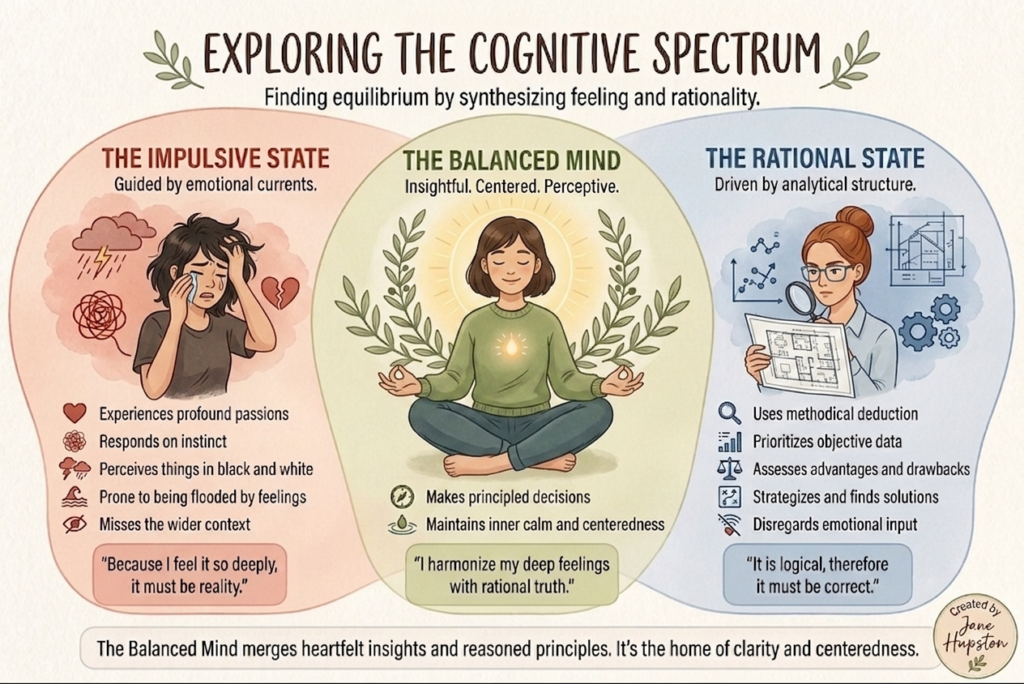
The emotional mind is the part of us that reacts primarily from feelings. When we are operating from emotional mind, our thoughts can become driven by fear, anxiety, frustration, sadness, or anger.
The wise mind is where emotion and reason come together. It allows us to acknowledge our feelings while also responding in a balanced and thoughtful way.
When overwhelm strikes, it is very easy to slip into emotional mind.
We start trying to solve everything at once. We imagine worst-case scenarios. We rehearse problems repeatedly in our heads. We feel an urgent need to “fix” everything immediately.
Unfortunately, this often increases overwhelm rather than reducing it.
Wise mind invites us to slow down. To pause. To breathe. To separate the facts from our fears. And to focus on what needs our attention right now rather than everything that might happen tomorrow, next week, or next year.
Sometimes the most powerful thing we can do is give ourselves permission to stop, reset, and regain perspective.
When everything feels urgent, it’s often a sign that we need to slow down rather than speed up.
Before trying to solve every problem, try to regulate your nervous system first.
Then ask yourself:
What is the very next step I need to take?
When we break things down into manageable pieces, our brains begin to feel safer and more capable again. This helps us move out of emotional mind and into wise mind, where clearer thinking becomes possible.
Sometimes overwhelm is triggered by an unexpected issue—a difficult email, a family problem, bad news, a financial concern, or a situation we weren’t prepared for.
When this happens, try not to react immediately.
Start by returning to the previous calming steps.
What is the actual problem I need to deal with right now?
Not every future version of the problem. Not every possible outcome.
Just today’s problem.
Next, consider:
What’s the worst realistic outcome here?
Often, when we take a moment to explore this calmly, we realise our minds have been filling in gaps with fear and uncertainty.
Once you have identified the problem, focus on finding one practical step towards a solution.
Most of the time, situations are far more manageable than they first appear when viewed through the lens of overwhelm.
One of the most important lessons in managing overwhelm is learning the difference between what is within our control and what isn’t.
We cannot control other people’s behaviour, choices, opinions, or reactions.
We cannot control every unexpected challenge life places in our path.
What we can control is how we respond, the boundaries we set, the support we seek, and where we choose to invest our time and energy.
There is a great deal of peace to be found in recognising that not every problem is yours to solve and not every burden is yours to carry.
Be gentle with yourself as you notice which people, situations, and habits leave you feeling supported and grounded.
And as you move forward, allow yourself to create a little more space for the relationships, routines, and choices that help you feel safe, valued, and connected.
Sometimes coping with overwhelm begins not with doing more, but with treating yourself with the same kindness and understanding that you would offer to someone you love.
Jane Hupston, MBACP (Accred), NCS (Professional Accred)
Jane Hupston is an experienced Integrative Counsellor and Clinical Supervisor working with adults & adolescents experiencing anxiety, overwhelm, stress, relationship difficulties, bereavement, low self-esteem, and life transitions. Drawing on a range of evidence-based approaches, including Person-Centred Therapy, Solution Focused Therapy, Dialectical Behaviour Therapy (DBT), and Cognitive Behavioural Therapy (CBT), Jane tailors her work to the unique needs of each individual.
Through her counselling practice, Jane supports clients in developing practical coping strategies, strengthening emotional resilience, and creating meaningful, lasting change in their lives.
To book an appointment please ring Jane on 07792847171